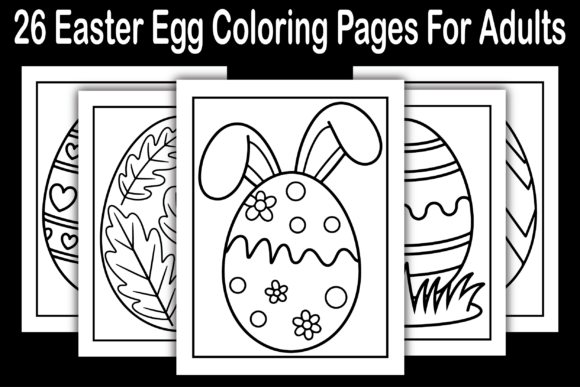
26 Easter Egg Coloring Pages for Adults
As a designer who’s stitched Easter motifs on everything from organic cotton tea towels to baby onesies—and sold dozens of embroidery kits through my own Etsy shop—I opened the 26 Easter Egg Coloring Pages for Adults bundle with quiet curiosity, not hype. I wasn’t looking for “cute.” I was asking: Will this translate cleanly into thread? Will it hold up on a curved cap brim or a stretchy toddler bodysuit? And most importantly—will my customers feel the care in the final handmade product?
A First Impression That Feels Like Spring, Not Stock Art
The moment you scroll through the 26 Easter Egg Coloring Pages for Adults, you notice what’s not there: no overworked gradients, no pixelated edges, no forced symmetry that reads as digital instead of hand-drawn. These are clean, confident line art illustrations—some with delicate cross-hatching, others with open negative space, a few with subtle botanical flourishes like sprigs of lavender or tiny daisies winding around the egg contours. The mood is calm, intentional, and quietly joyful—not saccharine or frantic. That matters. When you’re digitizing for machine embroidery, clarity in the original graphic is your first stabilizer.
Where This Bundle Earns Its Place in Real Embroidery Projects
I tested one of the more detailed eggs—a softly scalloped design with fine vine borders—as a custom embroidered tote bag for a local boutique. We used medium-weight canvas, tear-away + cut-away stabilizer combo, and 40-weight rayon thread. Result? Crisp satin stitch borders held their shape, the open interior areas translated beautifully into breathable fill stitch, and the overall density stayed balanced—no puckering, no stiffness. Customers commented on how “light” and “hand-finished” it looked—even though it was machine-embroidered.
This same design worked just as well scaled down to a 3-inch hoop for a personalized baby blanket corner, and scaled up (with minor cleanup) for a patch on an apron. The consistent line weight across all 26 Easter Egg Coloring Pages for Adults means you’re not fighting inconsistent stroke thickness when digitizing—or worse, discovering halfway through stitching that a “delicate swirl” becomes a tangled mess of underlay.
Use With Care: Where Detail Meets Reality
That said—these aren’t all-purpose graphics. A few designs include very tight inner patterns (think tiny concentric circles or micro-dots inside egg halves). On thin fabric like voile or lightweight linen, those areas risk showing stabilizer shadow or thread bleed-through. On dark fabric, especially with light thread, test contrast early: some fine linework disappears unless you add a subtle underlay or switch to a slightly heavier thread weight.
For curved surfaces like caps or hats, avoid the most intricate center-heavy eggs. Opt instead for designs with strong outer borders and open centers—the shape anchors itself better on a dome. And if you’re planning applique design integration (say, fabric egg shapes layered over top), choose eggs with clear, unbroken outlines—three of the 26 Easter Egg Coloring Pages for Adults have intentionally broken lines for coloring effect, which don’t digitize cleanly for applique placement.
How It Shapes Perception—Before and After Stitching
What surprised me most was how much the 26 Easter Egg Coloring Pages for Adults elevated perceived value—not just visually, but emotionally. A customer buying a personalized sweatshirt with one of these eggs didn’t just get “an Easter design.” They got something that felt curated, thoughtful, and quietly sophisticated. That translates directly to customer trust, repeat orders, and word-of-mouth referrals. For Etsy sellers and small shop owners, that’s gold.
It also supports brand consistency. Because the style is cohesive—not a grab-bag of mismatched clipart—you can use multiple eggs across different products (a pillow cover, a tea towel, a greeting card insert) and still feel like part of a seasonal collection. No jarring tonal shifts. No “where did this random chick come from?” confusion.
Practical Notes Every Embroidery Designer Should Keep Handy
- Always test on scrap fabric first—especially with textured weaves like burlap or terry cloth. Some fine linework softens or blurs depending on nap.
- Check thread color contrast in both light and dark mockups. What reads as elegant on ivory linen may vanish on navy denim.
- Review stitch density before production. Dense fill areas in larger eggs may need reduced density or alternate stitch types (e.g., tatami instead of solid fill) for breathability on apparel.
- Confirm hoop size compatibility. While the originals are scalable, ultra-fine interior details may not survive aggressive resizing below 2.5 inches without manual cleanup.
- Inspect small corners and junctions. Hand-drawn charm is lovely—but sharp interior angles at intersections can cause jump stitches or tension hiccups on older machines.
- Test black-and-white mockups. If it reads clearly without color, it’ll stitch cleanly with thread.
- Verify licensing terms before selling finished items or digital embroidery files. Since this is marketed for KDP interior and POD use, confirm whether commercial embroidery rights are included—or if you need separate permission for stitched goods.
Final Thought: A Quietly Versatile Asset for Makers Who Value Craft Over Clutter
The 26 Easter Egg Coloring Pages for Adults isn’t flashy. It won’t dominate a trade show booth. But it’s the kind of design asset that makes your craft business feel grounded, intentional, and human. Whether you’re stitching a single holiday gift for a neighbor or building a full Easter collection for your handmade shop, these pages offer reliable structure, gentle personality, and real-world adaptability. They respect the process—of coloring, of stitching, of making something meaningful by hand. And in today’s market, that kind of respect is rare. And valuable.